
Features
From the first word to the final take.
Write·For narrative designers
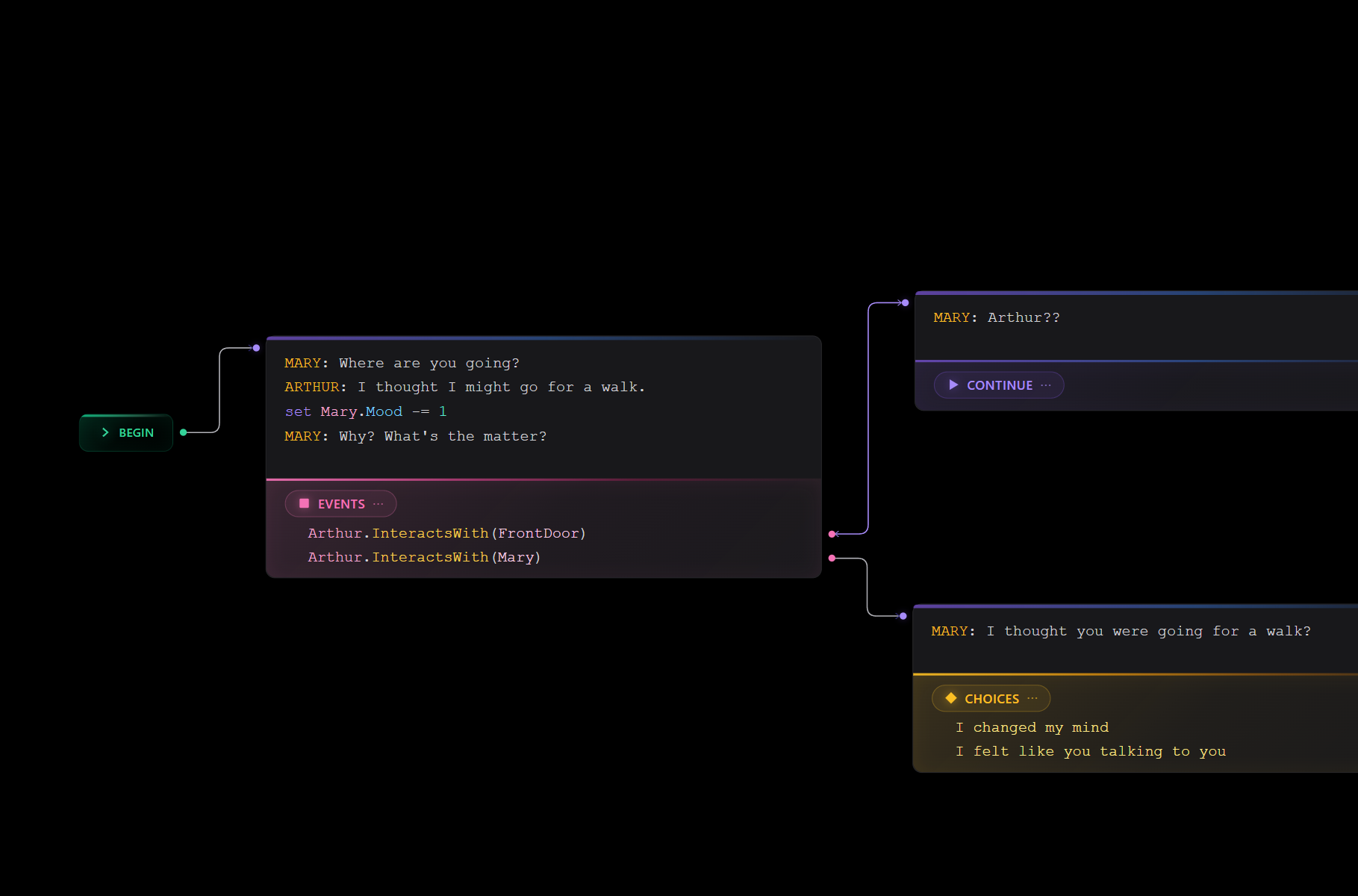
Write dialogue that branches.
A visual canvas for dialogue graphs with a writing-first syntax. Choices, conditions, events - all authored as text, rendered as a graph.
Integrate·For programmers
Ship narratives in Unreal Engine.
A native C++ plugin with a GAS-inspired action system, typed variable model, and clean JSON export. No lock-in.
Collaborate·For teams
Work together on the same story.
Real-time multiplayer editing, role-based access, and project organization for narrative teams of every size.
Validate·For QA & design leads
Know your story works before it ships.
Play through narratives in the browser. Catch dead variables and unreachable nodes automatically. Get five-second bug reports from testers with full session replay.
Produce·For producers
Know where every line stands.
Content status, VO recording, localization, and test coverage across your entire project. The production dashboard that answers “are we done?”
Platform roadmap
What we've shipped. What's next.
Write·Node-based graph editor
ShippedInfinite canvas with drag-and-drop dialogue nodes and connected edges.
Write·Writing-first syntax
ShippedPlain text dialogue with inline set, run, and when lines for game logic.
Write·Choices, conditions, and events
ShippedPlayer choices, condition gates, and event blocks with autocomplete and validation.
Write·Subgraphs
ShippedNested graphs that are structurally complete at every level, with breadcrumb navigation and scoped variables.
Integrate·Schema-versioned JSON export
ShippedFlat node arrays, typed exits, expression ASTs, and graph parameters.
Integrate·GAS-inspired action system
ShippedUNarrativeAction base class with async Begin/Complete/End lifecycle in C++ or Blueprint.
Integrate·C++ expression evaluator
ShippedAST tree-walker for conditions, interpolation, and set statements at runtime.
Integrate·State providers and services
ShippedVariables as UPROPERTYs accessed via reflection. No special base classes required.
Integrate·Live registry sync
ShippedUE plugin scans entity components at editor time, pushes live types to NarrativeStack.
Integrate·Graph parameters
ShippedDeveloper-defined scene metadata per graph - location, time of day, character placements - exported as typed structured data.
Validate·Live debug sessions
ShippedUE plugin streams the runtime cursor to the web editor. Step, pause, and inspect state in a running game.
Validate·In-browser play mode
In progressPlay through branching dialogue without launching Unreal. All conditions and interpolation work.
Validate·Static analysis
In progressDetect dead variables, unreachable nodes, loops, and contradictory conditions.
Collaborate·Real-time multi-user editing
PlannedConflict-free CRDT-powered editing with live cursors and selections.
Collaborate·Roles and permissions
PlannedOwner, Editor, Writer, and Viewer roles per project, server-enforced at every API call.
Collaborate·Project organization
PlannedProjects, graphs, and infinitely nested subgraphs with breadcrumb navigation.
Produce·Localization
PlannedTranslation overlay, untranslated string highlighting, CSV export/import, and runtime language switching.
Produce·Character system
PlannedCharacter sheets, expression-keyed portraits, voice actor references, and NPC response banks.
Write·Pre-production
PlannedBeat sheets, character profiles, and relationship maps that promote directly into dialogue graphs.
Validate·Test coverage analysis
ProposedNode, branch, and choice coverage aggregated across all playtest sessions.
Produce·VO inventory
ProposedAutomatic dialogue count by character, always in sync with the graph.
Produce·Studio-ready actor scripts
ProposedPer-character scripts with scene context, cue lines, and direction.
Produce·Recording status
ProposedPer-line recording states with auto-detection when text changes after recording.
Produce·Asset catalogue
ProposedVO recordings, character art, location references, music cues, and SFX linked to the nodes, characters, and scenes they belong to.
Produce·Production dashboard
ProposedContent completion, VO progress, and testing metrics in one view.